




WETEX 2026’s first day features 31 specialised seminars exploring key sustainability priorities
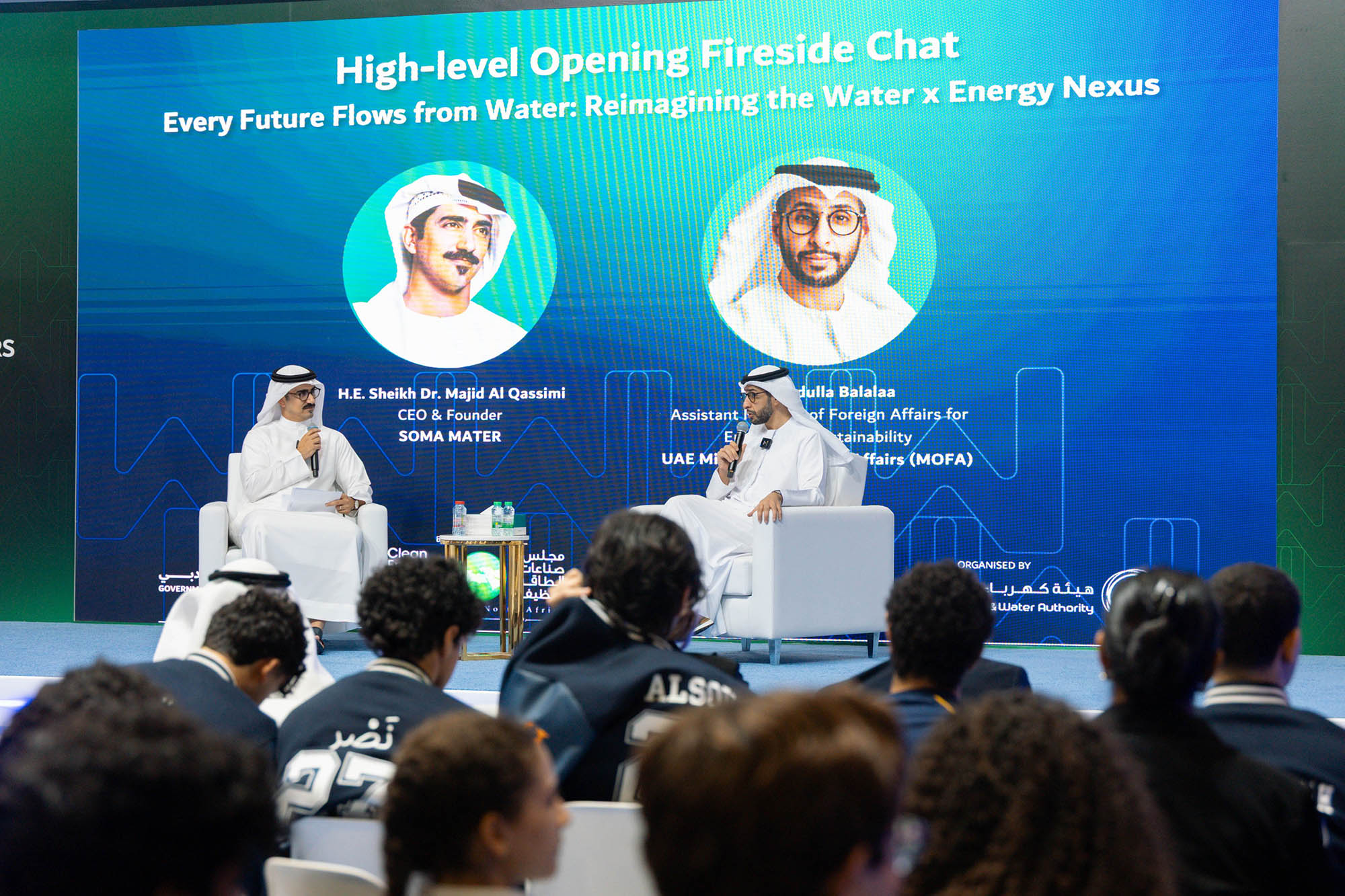
The first day of the 28th edition of Water, Energy, Technology and Environment Exhibition (WETEX), organised by Dubai Electricity and Water Authority (DEWA) at the Dubai World Trade Centre, featured 31 specialised seminars and sessions covering a wide range of topics, including clean and renewable energy, electricity grids, water, sustainability, health and safety, green mobility and supplier relations.
Main Seminars
Basil Almabrok, Executive Manager for Research and Development at Alfanar, presented the company’s next-generation medium-voltage switchgear during a session titled ‘From Following Standards to Setting New Benchmarks: alfanar’s Journey Toward the SF6-Free Grid’. He explained that alfanar has replaced SF6 across its product range with dry-air technology with zero global warming potential, noting that one kilogram (kg) of SF6 has the same global warming impact as 23,000kg of carbon dioxide. The company’s products have passed IEC tests at independent labs, including KEMA, at temperatures ranging from -35°C to 55°C, helping reduce supply-chain risks. Almabrok expects digital asset-management pilots to begin within two years, followed by mainstream adoption within five years.
In a session titled ‘EWEC’s Future Projects – An Overview on EWEC’s Upcoming Projects’, Omar Mohammed Al Ameri highlighted forthcoming projects spanning solar photovoltaic generation, battery energy storage and reverse-osmosis desalination, alongside measures to ensure reliable supply. He explained how long-term demand forecasting and integrated capacity planning guide project development and procurement, with government support and private-sector partnerships helping mitigate risks and attract investment. The presentation also explored opportunities for developers and investors to participate in future infrastructure projects, supporting more efficient, sustainable electricity and water production while strengthening long-term energy and water security.
During a session titled ‘Clean Energy – Green Hydrogen’, Omar Germouni, Head of Origination for Synthetic Fuels and Green Hydrogen at Acwa, said the GCC is well-positioned to produce electro-sustainable aviation fuel (e-SAF) – a synthetic fuel derived from renewable energy – at around 40% below European costs, supported by low-cost solar power and a share of around 10% of global air passenger traffic. He said Europe’s 2030 mandate would require about 600,000 tonnes of e-SAF, against a current capacity of 20,000 tonnes. A 1% regional mandate by 2030 would require 1.3 gigawatts (GW) to 1.5 GW and yield 130,000 tonnes to 140,000 tonnes, he said as he called for hub mandates, double-sided auctions and certification, alongside commitments from 2028 to underpin local demand and exports.
The session ‘Building Autonomous Organisations for a Sustainable World’ explored SAP’s vision for organisations that use AI to adapt, streamline operations and make better-informed decisions. Ernesto Schmitz, Business Transformation Lead at SAP, highlighted the importance of connecting business data and processes, enabling AI agents to coordinate workflows and automate tasks while people retain oversight. The approach aims to improve productivity, resource efficiency and sustainability.
In a session titled ‘525 KV HV DC Cables – Research Activities’, Altaf Ahmed, General Manager of the Technical and Quality Control Department at Riyadh Cables, announced the successful development of the company’s 525 kV HVDC cables, a technology new to the GCC capable of transmitting 2.6 GW to 3 GW of bulk power. The design features a 4,000 mm² aluminium keystone conductor and replaces lead with a welded aluminium sheath, reducing weight and environmental impact. Prototypes have passed electrical and non-electrical tests at an independent laboratory. The company, which employs about 4,700 employees and has operated a plant in Sharjah since 2000, is building its own type-test laboratory, positioning itself as a regional pioneer.
Chhandak Ghorai of Future Pipe Industries discussed corrosion-resistant composite pipes and non-destructive testing methods for assessing pipe and joint integrity during a session titled ‘The Digital Pipeline: Building Intelligent Water Networks for the Future’. He highlighted fibre-optic acoustic monitoring, SCADA systems, satellite-based detection, artificial intelligence (AI)-powered predictive modelling and digital twins as tools for identifying leaks and monitoring network performance. Citing Dubai’s water network losses of 4.4%, among the lowest globally, he emphasised the importance of quality manufacturing, effective installation and continuous monitoring in reducing water losses, improving operational efficiency and strengthening water infrastructure resilience.
The ‘Transformer Solutions for Solar Power’ session examined how transformers enable safe, efficient solar-grid integration by increasing voltage and reducing losses. A SUNTEN representative addressed electrical, thermal and environmental challenges, highlighting simulations, insulation, cooling and testing to improve reliability. The presentation also showcased prefabricated substations and dry-type and liquid-immersed transformers tailored to varying solar project requirements.
Renewables and Sustainability Seminars
During the panel discussion, ‘Energy Transition vs Energy Reality: Are We Pricing Transition and System Risk Correctly?’, Faisal Ali Rashid, Senior Director of Demand Side Management at the Dubai Supreme Council of Energy, highlighted Dubai’s advances in large-scale solar power, the Shams Dubai initiative and reverse-osmosis desalination, alongside the contribution of public-private partnerships. Representatives from Masdar and Positive Zero discussed renewable energy financing, interest-rate and project risks, and the importance of bankable contracts. Panellists also emphasised transparent data, consistent performance indicators and closer collaboration among governments, developers and financiers to attract investment and deliver reliable, affordable clean energy.
The panel discussion, ‘The New Energy Order: Navigating GCC Policy in an Evolving Global Landscape’, explored how geopolitical tension and rising electricity demand are reshaping energy security across the Gulf. Specialists from EtihadWE, Hitachi Energy, Schneider Electric, Fort Group and Rosatom stressed the need to protect supply routes, strengthen electricity and water infrastructure, and build grids resilient to cyber threats and disruptions. Panellists also addressed rising energy and water demand from AI and data centres, digitisation, local engineering capabilities, technological sovereignty, regional interconnections and supply-chain resilience, as well as the integration of renewables with other low-carbon energy sources. They called for predictable policies, long-term investment commitments and effective financing mechanisms to accelerate infrastructure development while maintaining affordability and advancing decarbonisation.
Water Seminars
In the session titled ‘Water Without Borders: Engineering Resilience, Empowering Peace’, Daniele Iacoboni, co-founder and Chief R&D Officer at ANECO Middle East, said safe water access depends on resilient, integrated treatment systems, particularly in remote areas and emergencies. He highlighted three priorities: removing barriers to access, ensuring operational resilience and building local expertise. Iacoboni showcased ARCA, a mobile treatment unit combining filtration, reverse osmosis and on-site electrochemical disinfection, while stressing the importance of energy integration, monitoring and maintenance. He also explored water reuse in industry, agriculture and data-centre cooling, citing a preliminary UAE study suggesting that a 50MW data centre could reduce annual water withdrawals by around 80% compared with fully evaporative cooling. He underscored the need for verified results and knowledge transfer to strengthen water security.
The session ‘Industrial Water Circularity as Enterprise Strategy’ explored why businesses must move beyond treating wastewater for disposal to recovering, reusing and extracting value from it. A Gradiant representative identified four measures for industrial water management: water intensity, reuse rates, brine discharge and resource recovery. The presentation examined minimum and zero liquid discharge (MLD and ZLD) and Gradiant’s Counterflow Reverse Osmosis (CFRO) solution, which concentrates brine while recovering more usable water. It highlighted a desalination project in Jeddah that achieved 50% additional freshwater recovery from previously discharged brine, alongside potential cost savings from integrating MLD and ZLD. The speaker stressed that circular water management strengthens water security, operational resilience and long-term business performance.
Health and Safety Seminars
The session titled ‘Discover the Future of HSE: Build Your Own AI + Vibe Coding Solution for Breakthrough Health & Safety Performance’, led by Bilal Dridi, examined how rapid advances in technology and AI are increasing the complexity of oil and gas operations. The session noted that while AI can reduce human error, simulate scenarios and improve monitoring, it also brings risks such as flawed data, overconfident responses and unclear accountability. Participants stressed the importance of human factors, safety culture and effective change management, and identified AI agents, advanced reasoning, AI platforms, vertical AI and sovereign AI as five key trends. The session concluded with a call for organisations to develop building custom AI solutions for health and safety.
The session titled ‘Building Trust in AI Systems: Transparency, Ethics, and Compliance – What it means’ featured Nahla Abid, Vice-President for the Southern Middle East at Bureau Veritas; Dr Jacinta Dsilva, co-founder and CEO/Regional Director at InLabs Group; Dr Sid Benraouane, Founder of the ‘42001’ Institute; Eftal Efecinar, co-founder and Chief Strategy Officer at Next Gen; and Ahmed Aljarouf, AI and Cybersecurity Lead at Bureau Veritas Cybersecurity. Panellists highlighted that building trust in AI requires transparency, ethical practices, robust governance and clear accountability. They called on organisations to ensure human oversight, critical thinking and verification of AI-generated output, while maintaining data traceability, protecting information and addressing legal, reputational and black-box risks. The session also addressed responsible AI adoption, highlighting international frameworks such as ISO 42001 alongside the importance of employee readiness and AI literacy. Panellists said accountability must extend across leadership, developers and users, citing Dubai’s ambition for AI to power 60% of government operations by 2030.
Green Mobility Seminars
The ‘Green Mobility Panel’ discussion, moderated by Maya Hojei, Senior Business Anchor at CNN Business Arabic, featured Walid Hizaoui, Group Chief Strategy Officer at Gargash Prime and Hisham Airan, Director of Operations at Dubai Taxi Company. It explored how Dubai can accelerate electric vehicle adoption by aligning government policies, charging infrastructure and commercially viable mobility solutions. Panellists discussed expanding charging networks and supporting the transition towards more sustainable transport fleets, emphasising the importance of assessing lifetime operating and maintenance costs alongside vehicle purchase prices. The discussion addressed challenges in electrifying heavy-duty vehicles and the potential of hydrogen and sustainable fuels for applications where electrification remains difficult. Speakers also highlighted car sharing, pedestrian and cycling infrastructure, and stronger connections with public transport as integral to sustainable urban mobility. They stressed the need for coordinated regulation, private-sector participation and continued investment to make cleaner transport more accessible and economically viable.
Supplier Relations Management Seminars
The sessions and panel discussions on supplier relations helped strengthen DEWA’s relationships with its suppliers, fostering closer partnerships and advancing sustainability and circular economy efforts.
